[maximum|minimum]_cycle_ratio
Calculates the maximum or minimum cycle ratio of a weighted directed multigraph using Howard’s iteration policy algorithm.
Complexity: Empirical O(|E|); space O(7|V|) plus graph storage
Defined in: <boost/graph/howard_cycle_ratio.hpp>
Example
#include <boost/graph/adjacency_list.hpp>
#include <boost/graph/howard_cycle_ratio.hpp>
#include <iostream>
#include <vector>

// Two bundled edge fields replace the nested
// `property<edge_weight_t, double, property<edge_weight2_t, double>>`.
struct Edge { double weight, transit; };

using namespace boost;
using Graph = adjacency_list<vecS, vecS, directedS, no_property, Edge>;

int main() {
    Graph g(3);
    // Cycle: 0->1->2->0 with weights 3,1,2 and transit times 1,1,1
    add_edge(0, 1, Edge{3.0, 1.0}, g);
    add_edge(1, 2, Edge{1.0, 1.0}, g);
    add_edge(2, 0, Edge{2.0, 1.0}, g);
    add_edge(0, 2, Edge{10.0, 1.0}, g);

    std::vector<graph_traits<Graph>::edge_descriptor> cycle;
    double mcr = minimum_cycle_ratio(g,
        get(vertex_index, g),
        get(&Edge::weight, g),
        get(&Edge::transit, g), &cycle);

    std::cout << "Minimum cycle ratio: " << mcr << "\n";
    std::cout << "Cycle length: " << cycle.size() << " edges\n";
}
Minimum cycle ratio: 2
Cycle length: 3 edges(1) maximum_cycle_ratio (default FloatTraits)
template <typename Graph, typename VertexIndexMap,
          typename EdgeWeight1, typename EdgeWeight2>
double maximum_cycle_ratio(
    const Graph& g, VertexIndexMap vim,
    EdgeWeight1 ewm, EdgeWeight2 ew2m,
std::vector<typename boost::graph_traits<Graph>::edge_descriptor>* pcc = 0);| Direction | Parameter | Description |
|---|---|---|
IN |
|
A weighted directed multigraph. The graph type must be a model of Vertex List Graph and Incidence Graph. |
IN |
|
Maps each vertex of the graph to a unique integer in the range
|
IN |
|
The W1 edge weight function. Must be a model of Readable Property Map. |
IN |
|
The W2 edge weight function. Should be nonnegative. The actual limitation of the algorithm is the positivity of the total weight of each directed cycle of the graph. Must be a model of Readable Property Map. |
OUT |
|
If non-zero then one critical cycle will be stored in the |
(2) maximum_cycle_ratio (custom FloatTraits)
template <typename FloatTraits, typename Graph, typename VertexIndexMap,
          typename EdgeWeight1, typename EdgeWeight2>
typename FloatTraits::float_type maximum_cycle_ratio(
    const Graph& g, VertexIndexMap vim,
    EdgeWeight1 ewm, EdgeWeight2 ew2m,
    std::vector<typename boost::graph_traits<Graph>::edge_descriptor>* pcc = 0,
FloatTraits = FloatTraits());| Direction | Parameter | Description |
|---|---|---|
IN |
|
Encapsulates customizable limits-like information for floating point types.
This type must provide an associated type, [source,cpp] ~~ template <typename Float = double> struct mcr_float { typedef Float value_type; static Float infinity() { return (std::numeric_limits<value_type>::max)(); } static Float epsilon() { return Float(-0.005); } }; ~~ The value |
IN |
|
A weighted directed multigraph. The graph type must be a model of Vertex List Graph and Incidence Graph. |
IN |
|
Maps each vertex of the graph to a unique integer in the range
|
IN |
|
The W1 edge weight function. Must be a model of Readable Property Map. |
IN |
|
The W2 edge weight function. Should be nonnegative. The actual limitation of the algorithm is the positivity of the total weight of each directed cycle of the graph. Must be a model of Readable Property Map. |
OUT |
|
If non-zero then one critical cycle will be stored in the |
(3) minimum_cycle_ratio (default FloatTraits)
template <typename Graph, typename VertexIndexMap,
          typename EdgeWeight1, typename EdgeWeight2>
double minimum_cycle_ratio(
    const Graph& g, VertexIndexMap vim,
    EdgeWeight1 ewm, EdgeWeight2 ew2m,
    std::vector<typename boost::graph_traits<Graph>::edge_descriptor>* pcc = 0);
Same parameters as (1).
(4) minimum_cycle_ratio (custom FloatTraits)
template <typename FloatTraits, typename Graph, typename VertexIndexMap,
          typename EdgeWeight1, typename EdgeWeight2>
typename FloatTraits::float_type minimum_cycle_ratio(
    const Graph& g, VertexIndexMap vim,
    EdgeWeight1 ewm, EdgeWeight2 ew2m,
    std::vector<typename boost::graph_traits<Graph>::edge_descriptor>* pcc = 0,
    FloatTraits = FloatTraits());
Same parameters as (2).
(5) maximum_cycle_mean (default FloatTraits)
template <typename Graph, typename VertexIndexMap,
          typename EdgeWeightMap, typename EdgeIndexMap>
double maximum_cycle_mean(
    const Graph& g, VertexIndexMap vim,
    EdgeWeightMap ewm, EdgeIndexMap eim,
std::vector<typename graph_traits<Graph>::edge_descriptor>* pcc = 0);| Direction | Parameter | Description |
|---|---|---|
IN |
|
A weighted directed multigraph. The graph type must be a model of Vertex List Graph and Incidence Graph. |
IN |
|
Maps each vertex of the graph to a unique integer in the range
|
IN |
|
The edge weight function. Must be a model of Readable Property Map. |
IN |
|
Maps each edge of the graph to a unique integer in the range
|
OUT |
|
If non-zero then one critical cycle will be stored in the |
(6) maximum_cycle_mean (custom FloatTraits)
template <typename FloatTraits, typename Graph, typename VertexIndexMap,
          typename EdgeWeightMap, typename EdgeIndexMap>
typename FloatTraits::float_type maximum_cycle_mean(
    const Graph& g, VertexIndexMap vim,
    EdgeWeightMap ewm, EdgeIndexMap eim,
    std::vector<typename graph_traits<Graph>::edge_descriptor>* pcc = 0,
    FloatTraits = FloatTraits());
Same parameters as (5), plus the FloatTraits template parameter described in (2).
(7) minimum_cycle_mean (default FloatTraits)
template <typename Graph, typename VertexIndexMap,
          typename EdgeWeightMap, typename EdgeIndexMap>
double minimum_cycle_mean(
    const Graph& g, VertexIndexMap vim,
    EdgeWeightMap ewm, EdgeIndexMap eim,
    std::vector<typename graph_traits<Graph>::edge_descriptor>* pcc = 0);
Same parameters as (5).
(8) minimum_cycle_mean (custom FloatTraits)
template <typename FloatTraits, typename Graph, typename VertexIndexMap,
          typename EdgeWeightMap, typename EdgeIndexMap>
typename FloatTraits::float_type minimum_cycle_mean(
    const Graph& g, VertexIndexMap vim,
    EdgeWeightMap ewm, EdgeIndexMap eim,
    std::vector<typename graph_traits<Graph>::edge_descriptor>* pcc = 0,
    FloatTraits = FloatTraits());
Same parameters as (5), plus the FloatTraits template parameter described in (2).
Description
The maximum_cycle_ratio() function calculates the maximum cycle ratio of a
weighted directed multigraph G=(V,E,W1,W2), where V is a vertex set,
E is an edge set, W1 and W2 are edge weight functions, W2 is nonnegative.
As a multigraph, G can have multiple edges connecting a pair of vertices.
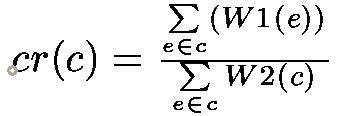
Let every edge e has two weights W1(e) and W2(e). Let c be a cycle of the graph g. Then, the cycle ratio, cr(c), is defined as:
The maximum (minimum) cycle ratio (mcr) is the maximum (minimum) cycle ratio
of all cycles of the graph. A cycle is called critical if its ratio is equal
to the mcr. The maximum_cycle_ratio()/minimum_cycle_ratio() returns
-FloatTraits::infinity()/FloatTraits::infinity() if graph has no cycles.
If the pcc parameter is not zero then one critical cycle will be written to
the corresponding std::vector of edge descriptors. The edges in the vector
stored in the way such that *pcc[0], *ppc[1], …, *ppc[n] is a correct path.
The algorithm is due to Howard’s iteration policy algorithm, described in [72]. Ali Dasdan, Sandy S. Irani and Rajesh K. Gupta in their paper Efficient Algorithms for Optimum Cycle Mean and Optimum Cost to Time Ratio Problems [73] state that this is the most efficient algorithm to the time being (1999).
For convenience, functions maximum_cycle_mean() and minimum_cycle_mean()
are also provided. These take an EdgeIndexMap instead of the two separate
edge weight maps (EdgeWeight1 and EdgeWeight2).
Returns
The calculated maximum (or minimum) cycle ratio. Returns
-FloatTraits::infinity() (for maximum_cycle_ratio) or
FloatTraits::infinity() (for minimum_cycle_ratio) if the graph has no
cycles.
The program in libs/graph/example/cycle_ratio_example.cpp
generates a random graph and computes its maximum cycle ratio.