Planar Canonical Ordering
Computes a canonical ordering of the vertices of a maximal planar graph.
Complexity: O(n + m)
Defined in: <boost/graph/planar_canonical_ordering.hpp>
Example
#include <boost/graph/adjacency_list.hpp>
#include <boost/graph/boyer_myrvold_planar_test.hpp>
#include <boost/graph/planar_canonical_ordering.hpp>
#include <iostream>
#include <vector>

using namespace boost;

struct Edge { int idx; };

using Graph = adjacency_list<vecS, vecS, undirectedS, no_property, Edge>;
using Vertex = graph_traits<Graph>::vertex_descriptor;
using Descriptor = graph_traits<Graph>::edge_descriptor;

int main() {
    // Start with a triangle (already maximal planar for 3 vertices)
    Graph g(3);
    add_edge(0, 1, g); add_edge(1, 2, g); add_edge(0, 2, g);

    int i = 0;
    for (auto e : make_iterator_range(edges(g))) { g[e].idx = i++; }

    std::vector<std::vector<Descriptor>> storage(num_vertices(g));
    auto embedding = make_iterator_property_map(storage.begin(), get(vertex_index, g));
    boyer_myrvold_planarity_test(boyer_myrvold_params::graph = g,
        boyer_myrvold_params::embedding = embedding);

    std::vector<Vertex> order;
    planar_canonical_ordering(g, embedding, std::back_inserter(order),
        get(vertex_index, g));

    std::cout << "Planar canonical ordering:";
    for (auto v : order) { std::cout << " " << v; }
    std::cout << "\n";
}
Planar canonical ordering: 0 1 2Synopsis
template <typename Graph, typename PlanarEmbedding,
          typename OutputIterator, typename VertexIndexMap>
void planar_canonical_ordering(
    const Graph& g,
    PlanarEmbedding embedding,
    OutputIterator ordering,
VertexIndexMap vm);| Direction | Parameter | Description |
|---|---|---|
IN |
|
An undirected graph. The type |
IN |
|
A model of PlanarEmbedding. |
OUT |
|
An OutputIterator with |
IN |
|
A Readable Property Map that maps vertices from |
Description
A planar canonical ordering is an ordering v1, v2, …, vn of the vertices of a maximal planar graph having the property that, for each k, 3 <= k < n, the graph induced by v1, v2, …, vk:
-
is biconnected and contains the edge {v1, v2} on its outer face.
-
has any vertices in the range v1, v2, …, vk that are adjacent to v(k+1) on its outer face, and these vertices form a path along the outer face.
Let Gk be the graph induced by the first k vertices in the canonical ordering, along with all edges between any of the first k vertices. After Gk has been drawn, the (k+1) st vertex can be drawn easily without edge crossings, since it’s adjacent only to a consecutive sequence of vertices on the outer face of Gk.
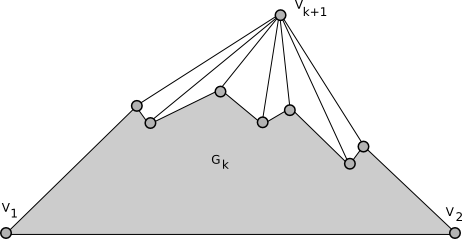
A planar canonical ordering exists for every maximal planar graph with at least 2 vertices.
planar_canonical_ordering expects the input graph to have at least 2 vertices.
The planar canonical ordering is used as an input in some planar graph drawing algorithms, particularly those that create a straight line embedding. de Fraysseix, Pach, and Pollack [66] first proved the existence of such an ordering and showed how to compute one in time O(n) on a maximal planar graph with n vertices.
See also example/canonical_ordering.cpp.